
In 2026, a compliance audit trail is no longer a passive log of system changes; it's an active, AI-curated narrative of regulatory adherence. Relying on manual record-keeping in an era defined by the EU AI Act and NIST CSF 2.0 is a strategic liability. You've likely felt the strain of reconciling disparate spreadsheets whilst fearing that subtle conduct risks remain hidden within customer interaction data. The escalating cost of external consultants for periodic audit preparation is no longer a viable operational expense. This article explores how compliance audit trail automation enables your firm to transition from fragmented data silos to a sophisticated, AI-driven evidence framework designed to satisfy the most stringent regulatory scrutiny.
We agree that the pressure to maintain continuous audit-readiness is relentless, especially with the Digital Services Act enforcing penalties of up to 6% of global revenue. You'll discover how to establish a single source of truth for all compliance evidence, ensuring your board reporting and FCA submissions take hours rather than weeks. We'll preview the technological shift from technical compliance to strategic governance, highlighting how real-time monitoring and unified data architectures provide the absolute certainty required in today's high-stakes financial environment.
Key Takeaways
- Understand how compliance audit trail automation shifts your posture from periodic, point-in-time snapshots to a state of continuous, algorithmic readiness that meets 2026 standards.
- Learn to unify disparate data streams from CRMs and telephony systems into a singular, defensible evidence framework that identifies conduct risk patterns amongst your customer interactions.
- Quantify the operational impact of replacing manual reporting scrambles with automated systems, allowing your compliance team to focus on high-level risk strategy rather than data retrieval.
- Discover a phased framework for integrating automated evidence tracking into your existing architecture using "compliance by design" principles to ensure seamless regulatory alignment.
- Explore how platforms like RegulaCX establish a new standard for Consumer Duty monitoring by providing real-time, audit-ready reporting on customer interactions and outcomes.
From Static Logs to Dynamic Proof: The Evolution of Compliance Audit Trail Automation
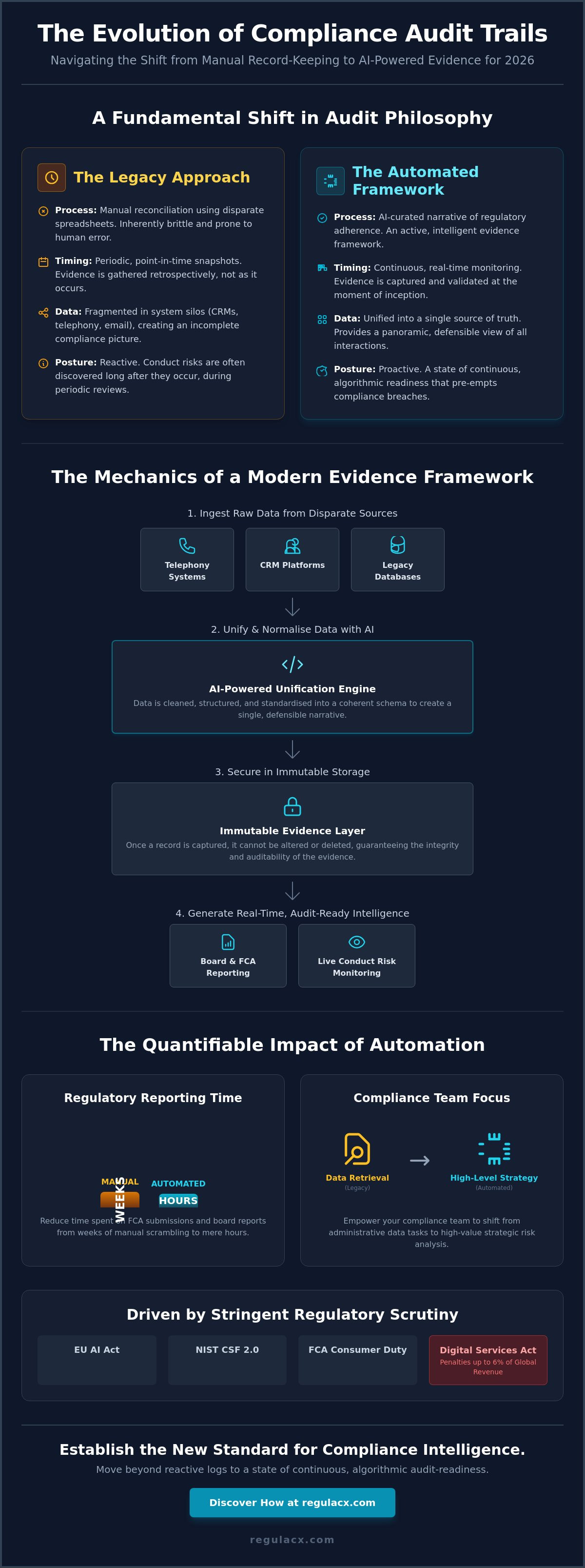
Legacy audit methodologies have reached their functional limit. For decades, firms relied on static logs; digital footprints that merely recorded system access or file modifications. In the current regulatory environment, these reactive records are insufficient. Compliance audit trail automation represents the transition to a continuous, algorithmic collection of regulatory evidence. It is no longer enough to prove that a system functioned; you must now prove that every customer interaction adhered to specific conduct standards. This requires a shift from "system logs" to "compliance intelligence." While traditional IT logs track technical changes, compliance intelligence monitors the qualitative nuances of customer outcomes. The era of manual spreadsheet reconciliation is over. Real-time data streaming has replaced periodic sampling, ensuring that evidence is captured at the moment of inception rather than weeks later during a retrospective review.
Why Manual Audit Trails Fail the Consumer Duty Test
Manual data entry is inherently brittle. In high-volume financial environments, the fragility of human-led record-keeping creates systemic risk. A single missed entry amongst thousands of transactions isn't merely a clerical error; under the scrutiny of the FCA, it's often categorised as regulatory negligence. Human oversight cannot scale at the speed of modern digital finance. When risk detection relies on manual reconciliation, a dangerous latency period emerges. This gap between the occurrence of a conduct risk and its eventual discovery is where the most significant regulatory damage occurs. Automated systems eliminate this delay, moving beyond the limitations of human capacity to provide a persistent, unalterable record of every interaction.
The Regulatory Mandate for Continuous Monitoring
The FCA's expectations regarding evidence have evolved toward extreme granularity. Regulators no longer accept broad summaries or anecdotal proof of compliance. They demand raw, verifiable data that demonstrates specific customer outcomes over time. Compliance audit trail automation creates a living, breathing record of regulatory adherence that remains accessible and defensible at any moment. This shifts the internal culture from "preparing for an audit" to maintaining a permanent state of audit-readiness. It is a fundamental architectural change. By integrating evidence collection directly into operational workflows, firms ensure that the audit trail is a byproduct of the process itself, rather than a separate, administrative burden. This level of transparency is the new baseline for firms operating in 2026, where the ability to produce immediate, high-fidelity evidence is the ultimate measure of a firm's integrity.
The Mechanics of Modern Evidence: Unifying Data for Real-Time Oversight
Effective oversight requires a panoramic perspective. Fragmented system logs are insufficient for 2026 regulatory standards; they provide only isolated snapshots of activity. Modern compliance audit trail automation relies on the seamless unification of disparate data streams to create a coherent, defensible narrative. This process involves extracting raw data from legacy databases, telephony systems, and CRM platforms, then normalising it into a standardised schema. Once unified, this data must be housed in immutable storage layers. This ensures that once a record is captured, it cannot be altered or deleted. Integrity is the foundation of auditability. Without it, evidence is merely a claim; with it, evidence becomes technical proof. Integrating these modern AI layers with legacy "siloed" systems remains a primary technical challenge, yet it's a necessary evolution for firms that value absolute certainty.
Data Unification: Breaking Down Compliance Silos
Compliance silos are operational liabilities. When customer interaction data is scattered across email servers and call recordings, conduct risk remains invisible. Normalising this data into a central intelligence layer allows for precise timestamping and sequencing. This chronological precision is vital. It enables the system to reconstruct the exact order of events during a customer journey, proving that required disclosures were made before a transaction occurred. Establishing this central layer is a strategic priority. For firms looking to modernise their architecture, cross-system compliance data unification provides the necessary infrastructure to bridge the gap between legacy storage and real-time oversight.
AI-Powered Detection vs. Simple Keyword Flagging
Basic automation often relies on "if-this-then-that" logic or simple keyword flagging. These methods are blunt instruments. They lack the sophistication to understand the context of a customer interaction, leading to an overwhelming volume of false positives. Sophisticated AI conduct risk detection operates differently. It utilises machine learning to analyse the sentiment and intent amongst disparate data sets. It doesn't just look for specific words; it identifies patterns of behaviour that indicate vulnerability or potential harm. By filtering out noise and focusing on high-probability risks, these systems allow compliance teams to act with precision. The result is a drastic reduction in manual review hours and a significant increase in the accuracy of regulatory evidence.
Manual Scrambles vs. Continuous Readiness: Evaluating the ROI of Automation
The financial burden of manual evidence collection is often obscured by operational inertia. Firms frequently underestimate the cumulative cost of staff hours dedicated to retrospective data gathering; a process that is both inefficient and prone to systemic error. Relying on compliance teams to act as manual data-gatherers creates a significant opportunity cost. Instead of functioning as risk architects and strategic advisors, highly skilled professionals are relegated to administrative roles, sifting through disparate spreadsheets to reconstruct past events. Compliance audit trail automation eliminates this inefficiency. By moving to a model of continuous readiness, firms replace the "annual scramble" with a persistent state of oversight. This transition drastically improves the speed of incident response. When a potential breach is detected, remediation can begin immediately because the evidence is already unified and accessible. This level of transparency is essential for high-level board reporting, providing executives with defensible data that demonstrates proactive governance rather than reactive damage control.
The Financial Case for Compliance Automation
Investing in a permanent AI-powered platform is a strategic alternative to the recurring expense of external consultancy fees. Periodic audit reviews are snapshot-based and expensive; they offer no protection between assessments. In contrast, automated systems provide 365-day coverage, significantly mitigating the risk of multi-million pound FCA fines resulting from undetected conduct failures. The presence of "clean," structured data also reduces the duration and complexity of external audits, leading to lower professional service costs. When evidence is organised and verifiable at the point of entry, the need for extensive manual verification by third parties is largely removed.
Beyond Cost: The Strategic Value of Audit Intelligence
Audit intelligence offers value that extends far beyond simple risk mitigation. The data captured within an automated trail provides deep insights into customer behaviour, which can be utilised to inform better product design and enhance service delivery. For individuals holding personal liability under the Senior Managers and Certification Regime (SM&CR), this technical certainty provides vital peace of mind. Knowing that every customer interaction is monitored and recorded in an immutable format reduces the personal risk associated with regulatory oversight. Ultimately, this transparency builds long-term trust with regulators. It demonstrates that a firm is not merely meeting the minimum requirements but is establishing a new standard for accountability and customer protection.
Implementing Automated Evidence Tracking: A Framework for Financial Institutions
Transitioning to compliance audit trail automation isn't merely a technical migration. It's a structural realignment that embeds regulatory requirements directly into your data architecture. This "compliance by design" approach ensures that evidence collection is a byproduct of operational activity, not an afterthought. Success depends on deep collaboration between IT, Legal, and Risk departments to define the parameters of what constitutes a conduct breach. IT provides the plumbing; Legal ensures data privacy and retention policies are met; Risk defines the thresholds for intervention. Without this cross-departmental synchronisation, automated systems risk becoming expensive noise generators rather than precision oversight tools.
Phase 1: Identifying Data Sources and Regulatory Gaps
The first phase requires a comprehensive audit of your existing data landscape. You must map every system where customer interaction or conduct data resides, including CRM platforms, telephony servers, and email archives. This process often reveals critical "blind spots" where evidence is currently missing or relies on manual entry. Under the UK's Consumer Duty mandate, these gaps are unacceptable. You must prioritise data streams based on high-risk regulatory outcomes, such as interactions with vulnerable customers or the sale of complex financial products. Identifying these vulnerabilities early allows you to focus your automation efforts where the risk of regulatory harm is most acute.
Phase 2: Integrating the Intelligence Layer
Once data sources are mapped, you must integrate a central intelligence layer. Selection criteria for an AI-powered platform should prioritise API-first architectures. This ensures seamless integration with both legacy systems and modern cloud services without requiring a total infrastructure overhaul. The intelligence layer doesn't just store data; it interprets it. You'll need to train the AI to recognise specific firm-level risks and behaviours that align with your internal policies. This involves setting granular risk thresholds for automated alerts, such as flagging sentiment shifts in a call or identifying deviations from approved sales scripts. For firms seeking to establish this level of precision, Consumer Duty monitoring and evidence automation provides the necessary framework to unify these disparate data points into a single, defensible audit trail.
Setting these thresholds is an iterative process. It requires ongoing calibration to ensure the system remains sensitive to emerging conduct risks whilst minimising false positives. By establishing a robust "risk score" for every interaction, your compliance team can move from manual sampling to exception-based monitoring. This allows them to intervene in real-time before a subtle conduct risk escalates into a systemic regulatory failure.
RegulaCX: Establishing the New Standard for Audit-Ready Compliance Intelligence
RegulaCX represents the vanguard of compliance audit trail automation. It is a purpose-built intelligence layer designed to resolve the complexities of modern financial oversight. By unifying cross-system data into a single, defensible evidence framework, the platform eliminates the inherent risks of fragmented record-keeping. The manual scramble that typically precedes regulatory reporting cycles is replaced by a streamlined, automated workflow. This transition isn't just about efficiency; it's about establishing a state of perpetual audit-readiness that satisfies the most rigorous external scrutiny. RegulaCX doesn't just store logs; it curates a narrative of compliance that is both unalterable and immediately accessible.
Engineered for Consumer Duty and Conduct Risk
RegulaCX is specifically architected to meet the exacting demands of the UK's Consumer Duty. It automates the collection of granular evidence across every stage of the customer journey, ensuring that no interaction remains unmonitored. The platform provides real-time oversight of customer interactions and complaints, identifying patterns of potential harm amongst disparate data sets that manual sampling would inevitably miss. This level of vigilance produces "audit-ready" reporting outputs designed for immediate submission to regulators or presentation to the Board. It transforms raw data into defensible intelligence, proving that your organisation isn't just following rules but is actively delivering the outcomes required by the FCA.
Seamless Integration, Absolute Certainty
The platform's cloud-based, AI-driven architecture is built for transparency. It avoids the "black box" problem by providing clear, explainable insights into how risks are detected and prioritised. Integration with legacy systems is handled via robust APIs, ensuring that your existing data becomes a source of strength rather than a technical bottleneck. RegulaCX acts as a vigilant guardian, detecting subtle conduct risks before they manifest as systemic breaches. This proactive protection provides the absolute certainty required to navigate the high-stakes regulatory environment of 2026. Discover how RegulaCX automates your compliance evidence today.
Establishing a Permanent State of Regulatory Certainty
The transition to compliance audit trail automation isn't merely a software upgrade; it's a fundamental shift in how firms defend their integrity. You've seen how unifying disparate data streams into a single intelligence layer removes the systemic risk of manual reconciliation. By embedding "compliance by design" into your architecture, you transform raw customer interactions into defensible proof of conduct. This level of technical precision is the only way to navigate the complexities of 2026 regulations like the EU AI Act and the UK's Consumer Duty.
RegulaCX was built specifically for these rigours, automating Consumer Duty evidence across disparate systems whilst providing real-time conduct risk detection. It's time to replace the manual scramble with board-ready reporting that stands up to the most intense scrutiny. Request a technical briefing on RegulaCX’s automated evidence platform to secure your firm's future. Achieving absolute transparency is within reach.
Frequently Asked Questions
What is compliance audit trail automation?
It's the continuous, algorithmic collection and unification of regulatory evidence across an organisation's digital architecture. Instead of manual sampling, it utilises automated data extraction to create a persistent record of every customer interaction and system change. This ensures that evidence is captured at the point of origin, maintaining a permanent state of audit-readiness without human intervention or the risks associated with retrospective data gathering.
How does automated audit trail software improve Consumer Duty compliance?
It provides high-fidelity evidence of customer outcomes by monitoring qualitative data across telephony, CRM, and email platforms. Under Consumer Duty, firms must prove they're delivering good outcomes. Automation tracks the entire journey, flagging potential harm in real-time. This allows for immediate remediation and generates board-ready reporting that demonstrates proactive adherence to the FCA's specific conduct requirements and transparency mandates.
Can AI-driven audit trails replace manual compliance officers?
No; they augment the capabilities of compliance professionals by removing the burden of manual data gathering. AI-driven systems act as a force multiplier, identifying patterns amongst millions of interactions that humans can't physically process. This allows compliance officers to transition from administrative data collection to high-level strategic risk management and targeted intervention, focusing their expertise where it's most needed.
How do you ensure the integrity of an automated audit trail?
Integrity is maintained through immutable storage and cryptographic timestamping. Once data is captured from a source system, it's normalised and housed in a write-once-read-many (WORM) environment. This prevents any alteration or deletion of the record. Sophisticated compliance audit trail automation also includes architectural verification to ensure data remains consistent and defensible across the entire lifecycle of the evidence tracking process.
What are the main challenges when implementing audit trail automation in finance?
The primary obstacles involve cross-system data unification and the normalisation of legacy data formats. Financial institutions often operate with siloed architectures where customer data is fragmented across various on-premises and cloud platforms. Successfully bridging these gaps requires an API-first intelligence layer that can extract raw data without disrupting core operations. Aligning internal risk thresholds with automated alert logic is another critical technical step.
Is automated compliance evidence accepted by the FCA?
Yes, provided the evidence is granular, verifiable, and demonstrates specific customer outcomes. The FCA increasingly expects firms to utilise technology for continuous monitoring. Automated trails offer a level of precision and transparency that manual samples can't match. By providing raw, unalterable data rather than anecdotal summaries, firms can demonstrate a more robust and defensible approach to regulatory oversight and conduct risk management.
How does RegulaCX handle data from legacy financial systems?
RegulaCX utilises a sophisticated ingestion layer designed to normalise data from diverse, siloed environments. It connects to legacy telephony and CRM systems via secure APIs or structured data exports, extracting the raw interaction data for analysis. The platform then unifies this information into a standardised schema. This process ensures that even older systems contribute to a modern, unified audit narrative without requiring a total infrastructure replacement.
What is the difference between a system log and a compliance audit trail?
A system log records technical events; a compliance audit trail narrates regulatory adherence. System logs track who accessed a file or when a server restarted. In contrast, compliance audit trail automation captures the qualitative context of business conduct, such as what was said during a customer call. It maps operational data directly to regulatory obligations to prove specific outcomes, whereas IT logs focus purely on system state.